Artificial intelligence (AI) and chatbots are nothing particularly new to the maintenance sector. Most sectors have begun using chatbots as part of their overall business operations. We have recently developed a similar innovation, the Fiix Maintenance Copilot, a Gen-AI-powered chatbot designed to resolve asset issues faster with instant answers to your maintenance questions. In this blog, we’ll review Fiix Maintenance Copilot and how it fits into our other product lines. We’ll also discuss the other ways that chatbots are making their way into maintenance and manufacturing.
What is Fiix Maintenance Copilot?
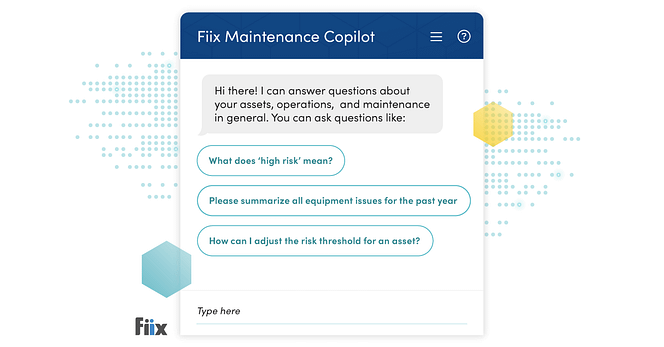
Managing day-to-day activities for maintenance teams can be complex and time-consuming. However, Fiix Maintenance Copilot(opens in new tab) is here to simplify and enhance the maintenance process by capturing your maintenance knowledge in one place, surfacing answers to your maintenance problems faster, and being a conversational and convenient operator for every maintenance team. It works like other chatbot experiences in that it’s a window that pops up a chat-style expertise for team members to ask questions regarding an Fiix Asset Risk Predictor (ARP)(opens in new tab) enabled asset. The information from the asset is stored in a knowledge base for the team to retain.
Fiix Maintenance Copilot can quickly answer questions about your ARP-enabled assets without having to manually review all of your data and documentation. This brings me to my next point: reviewing Fiix ARP and how it fits into the bigger picture of your maintenance.
What is Fiix ARP and how does Fiix Maintenance Copilot fit into it?
According to Mohammad Esmalifalak, Lead Data Scientist at Fiix, ARP, Fiix Prescriptive Maintenance(opens in new tab), and Fiix Maintenance Copilot should be distinct from three separate products, but one. “Fiix ARP detects anomaly operations, and then Fiix Prescriptive Maintenance prescribes solutions to help resolve the issues and prevent potential failures; our latest addition to this product line is Fiix Maintenance Copilot. They work together, not separately,” says Mohammad. He added that the Fiix Maintenance Copilot solves some of the common challenges that maintenance teams face when quickly finding information on an asset. Some benefits of Fiix Maintenance Copilot are:
Time-saving: It streamlines maintenance processes by providing quick access to information, interactive troubleshooting, and around-the-clock support. This can reduce downtime and increase productivity.
Accessibility: It offers support to technicians anytime, anywhere, 24/7, giving teams flexibility in their work environments.
User-friendly: The chatbot functionality makes it easy to interact with and answer questions, and it can access accumulated knowledge about maintenance procedures for the most critical assets.
Adaptability: The chatbot gets better over time and has machine learning (ML) capabilities, which lets it learn from user interactions and adapt responses over time.
“With this, product maintenance teams can get quick access to information versus searching and digging through the computerized maintenance management system (CMMS). It’s easy to use, and it gets better over time. The chatbot is equipped with machine learning capabilities, so it learns from user interactions and adapts,” says Mohammad. But if the product is learning and adapting, how do we keep data and information safe?
“An important question we often get is about customer safety with chatbots. For one thing, we’re not using an open-source platform for our chatbot, and like all Rockwell Automation platforms and products, our customer data and safety are there. We make sure that we don’t use any customer information for training any AI models that are open access or live outside the Rockwell secured instances as an extra measure of safety,” Mohammad added.
Fiix Maintenance Copilot’s versatility and adaptability make it a robust solution for maintenance teams looking to improve their operations.
How are chatbots benefiting maintenance teams?
Since chatbots are growing in popularity, many teams have begun using them internally and externally to manage their clients or partners. Internally in the manufacturing sector, teams often use chatbots to help with real-time troubleshooting and support, predictive maintenance, enhanced communication, and even sharing data-driven insights. Let’s review how some of these features are used in maintenance and manufacturing with examples:
Real-time troubleshooting and support: When machinery malfunctions, every minute of downtime translates into lost productivity and revenue. Chatbots provide real-time support by:
Offering diagnostic assistance: Analyzing symptoms and providing potential causes and solutions based on historical data and industry best practices.
Accessing knowledge base: Quickly retrieving information from manuals, past maintenance records, and technical documentation to assist technicians on the spot.
Guiding repairs: Providing a step-by-step for common repair procedures, ensuring that even less experienced technicians can perform tasks correctly.
Predictive maintenance: Preventing unexpected equipment failures can save teams time and costs, chatbots play a role by:
Analyzing data: Using machine learning (ML) algorithms to analyze data from sensors and other sources to predict when a machine is operating abnormally and is likely to fail.
Scheduling proactive maintenance: Recommending and scheduling maintenance activities before a failure occurs, reducing unplanned downtimes.
Optimizing maintenance schedules: Balancing maintenance activities to minimize disruptions to the manufacturing process while ensuring equipment reliability.
Enhanced communication and collaboration: Effective communication helps maintenance teams organize their day-to-day routines and tasks. Chatbots enhance this by:
Centralizing information: Providing a single platform for sharing updates, reporting issues, and tracking the status of maintenance activities.
Sending notifications: Alerting team members about upcoming maintenance tasks, critical issues, and status changes in real-time.
Facilitating collaborations: Enabling technicians to easily share insights, ask for help, and collaborate on complex issues through the chatbot interface.
Data-driven insights: Data is a powerful tool for improving maintenance strategies. Chatbots help in leveraging this data by:
Generating reports: Creating detailed reports on equipment performance, maintenance activities, and failure trends.
Analyzing trends: Identifying patterns and recurring issues to inform proactive maintenance strategies.
Providing recommendations: Offering actionable insights to optimize maintenance schedules, improve equipment reliability, and reduce costs.
Although Fiix Maintenance Copilot isn’t quite at the level of the above examples yet, it may still be a potential future for the product. “We’re just in the first stage of what’s possible with chatbots like ours. Right now, we’re just accessing from an internal knowledge base, but what happens if we go outside to something like Google? Now we’re expanding our knowledge reach, but we’d need to do so in a smart and safe way,” says Mohammad.
There’s so much potential for chatbots in the maintenance space, Fiix Maintenance Copilot is just one example,” Mohammad added.
By automating routine tasks, providing real-time support, enabling predictive maintenance, enhancing communication, and delivering data-driven insights, chatbots are becoming indispensable tools for maintenance teams.
Fiix Maintenance Copilot is designed to streamline maintenance teams’ tasks
With the number of tasks maintenance teams need to organize and keep track of new tools like chatbots can help teams keep up with the demands of their operations. Fiix Maintenance Copilot is a powerful Gen-AI-driven chatbot that offers a range of features to help teams access their knowledge base easily and quickly, ultimately saving them a lot of time and being a tool, they can lean on 24/7.
The transformation power of technology is intertwined with efficiency and progress. Despite emerging challenges, automation offers practical efficiencies and benefits the life sciences sector are starting to consider in future growth planning and mapping workflow requirements
Knowledge work automation is at the heart of this digital transformation. It redefines how tasks are executed across various sectors. Work automation is essential for modern businesses, from streamlining routine processes to driving higher productivity.
The life sciences sector stands to benefit most from process automation. Life sciences encompasses biotechnology, pharmaceuticals, and healthcare. The sector has been significantly transformed by workflow and lab automation. More than 70% of life sciences organizations use automation for research and development processes.
This statistic illustrates how much life sciences organizations have embraced advanced data analytics and automation software development. For example, they are allocating significant resources to support each step of drug development.
The intersection of automation and life sciences is more than merely a technological meeting watermark. It represents a pivotal moment in pursuing innovations that can reshape the industry. This includes both drug discovery and medical research.
The Evolution of Knowledge Work Automation
The concept of automating business tasks has evolved. Changes started with the automation of labor during the Industrial Revolution. It continued with the advent of early computing systems.
Knowledge work automation has come a long way thanks to emerging technology. Breakthroughs in artificial intelligence (AI), machine learning, and computing power have propelled automation beyond routine tasks and manual work.
Advanced technologies have empowered systems to manage high-level decision-making, data analysis, and complex problem-solving. Large to small businesses use workflow automation, from manufacturing to financial services and healthcare, to work smarter. It’s not just about reducing mistakes. It’s about gaining a competitive edge.
Applications of Work Automation in Life Sciences
Applications that improve the efficiency of scientific processes in the real world include
High-throughput screening involves automated techniques that rapidly analyze large samples, allowing researchers to efficiently identify potential drug candidates and conduct robust experiments.
Data analysis and interpretation: AI automation can process vast datasets quickly and precisely. This helps scientists uncover meaningful insights and patterns.
Robotic process automation (RPA):RPAis increasingly crucial in life sciences R&D. Laboratory process automation leverages robotics to process and manage samples. It also streamlines repetitive tasks, increasing productivity and enhancing flexibility and agility. Benefits include reduced manual processes, heightened accuracy, standardized workflows, and cost savings.
Robotics in sample handling reduces the risk of human error and increases the throughput and accuracy of laboratory workflows.
Automated liquid handling systems perform precise and repetitive liquid transfers. This ensures accuracy in experiments requiring careful measurement and mixing. By automating these tasks, labs can achieve higher levels of consistency.
Benefits of Knowledge Work Automation
Information automation increases efficiency and will improve productivity. How? By relieving professionals of routine and time-consuming tasks. This allows researchers to spend more time on high-value activities. The quest to increase the speed of innovation and discovery is facilitated by knowledge work automation. It contributes not only to streamlined processes, but also to knowledge workers’ professional growth and effectiveness.
Knowledge work automation also drives enhanced data accuracy. Automated systems minimize the risk of human error, ensuring precision in analyzing data and interpretation. This improves the reliability of results and elevates the overall quality of R&D.
Advancements in information technology for life sciences include handling clinical trial data and improved document management for contract research organizations. These include streamlined workflows, enhanced collaboration, and reduced risks. This drives excellence in business operations and strengthens relationships with sponsors.
Integrating technology-driven solutions ensures advantages extend beyond efficiency gains. They positively impact the life sciences industry, from project management to regulatory compliance and enhance overall customer experiences.
Addressing Challenges with AI and Automation
What are some obstacles with the automation in life sciences laboratories?
Financial challenges hinder the adoption of process automation systems.
Long-standing obstacles in practices of academic research create resistance to future automation.
Despite expected progress in future design of affordable, lower-level automation equipment, the market still needs further development.
Meeting growing demand for environmentally conscious automation poses a challenge for developers.
Ensuring systems remain compatible with the innovative nature of researchers, preserving the freedom to create new protocols.
Life sciences researchers now need working knowledge in both traditional biology “wet lab” skills and emerging “dry” automation skills.
Spatial constraints within laboratories and cultural challenges contribute to knowledge gaps, leading to a lag in automation software
Trends in the Future of Automation
As automation continues to evolve, a higher elevation of tools and systems will emerge. They will be used to further enhance R&D efficiency and productivity. AI-powered drug design represents a significant trend in the future of work automation.
The long term shift towards AI promises to transform the identification of potential candidates. It will accelerate research timelines and enhance the precision of therapeutic interventions.
Another emerging trend is the seamless addition of decision automation in personalized medicine. Automation technologies are expected to be crucial in customizing medical treatments to individual patient traits. This trend encompasses the automation of processes related to patient data evaluation, treatment customization, and the efficient delivery of personalized healthcare solutions. The combination of automation and personalized medicine will optimize patient outcomes.
FAQ
How does knowledge work automation in life sciences differ from traditional office automation systems?
Unlike traditional office automation, knowledge work automation in life sciences is customized for complex tasks in biotechnology, pharmaceuticals, and healthcare. It involves advanced processes such as data analysis, decision-making, and problem-solving.
Why should life sciences embrace the automation of knowledge work?
Automating knowledge work management in life sciences streamlines processes and save time. This allows professionals to focus on high-value activities and contributes to maximized effectiveness. It also accelerates drug development, healthcare, and medical research innovations.
What makes the automation of knowledge work disruptive for life sciences?
The automation of knowledge work in life sciences disrupts traditional workflows by introducing advanced technologies such as AI. AI improves speed, accuracy, and overall effectiveness. This disruption transforms how tasks are executed, fostering breakthroughs in healthcare, drug discovery, and research.
FAQs is plural for more than one FAQ, because FAQ stands for Frequently Asked Questions. [MF1]
The website GameFAQs has multiple sets of FAQs, each of which is an individual FAQ.
What can maintenance teams do to help meet the biggest business challenges of 2024? The impact of maintenance goes far beyond just downtime, so let’s dive into the results of Rockwell Automation’s 9th annual State of Smart Manufacturing Report (SoSM) to uncover the top obstacles facing manufacturers, how maintenance teams can help, and the useful technology investments delivering results.
The State of Smart Manufacturing
If you had to summarize this year’s SoSM report in one word, it might be “optimistic.” While the challenges facing manufactures are real, so are the potential solutions. In the face of economic headwinds, labor shortages, skills gaps, and cybersecurity concerns, decision-makers are turning to advanced industrial operations technology like AI to meet their concerns (SoSM, pg. 5). But before we get to the solutions, let’s breakdown the report’s top challenges to manufacturing growth in 2024.
By automating data analysis to generate predictive and prescriptive actions, industrial organizations can realize efficiency gains and overcome key challenges. – Sandy D’Souza, Fiix Product Expert
The Top Obstacles to Growth in 2024
As in previous years, this year’s SoSM report distinguishes between external and internal obstacles to growth.
Top 5 External Obstacles to Growth
Inflation
Rising energy costs
Cybersecurity risks
Shortages of skilled workers
Supply chain disruption
Unsurprisingly, rising inflation and energy prices topped the list as global events and supply-demand mismatches continue to impact companies in all sectors. In fact, inflation tops the list of external obstacles for the second year running. These pressures hit manufacturers particularly hard because they depend on physical inputs and often run comparatively energy-intensive operations.
Interestingly, the emergence of cybersecurity risks in the number three spot speaks to the double-edged nature of technological progress: As manufacturers invest in the interconnectivity between the physical and digital worlds through OT and IT technology, this progress has also brought with it novel security concerns.
Finally, skilled worker shortages and supply chain disruption continue to dampen growth, although there are some encouraging signs on the horizon that the supply chain issues may be finally coming to an end.
Topping this year’s list of internal growth obstacles, the global skilled labor shortage rears its head once again, with respondents agreeing on the difficulty of attracting new talent. Related to this, the challenge of deploying new technologies took the number two spot, with the difficulties compounded by the skills shortage.
Budget constraints and the endless tug-of-war between quality and growth took the number three and four spots, respectively, reflecting perennial business concerns.
Finally, the challenge of collecting and interpreting data for improvement was revealed to be widespread, capturing the number five spot.
How Maintenance Teams Can Help
Maintenance teams have a unique role to play in addressing these obstacles to growth. Far from being a silo or cost center, maintenance is in fact uniquely poised to help manufacturers rise to their challenges.
Here are the top ten ways maintenance teams can help meet both the external and internal challenges to growth we explored above.
External Obstacles
Inflation: Control maintenance costs by optimizing equipment performance, minimizing downtime, and extending asset lifespan, thus mitigating the impact of inflation on operational expenses.
Rising energy costs: By implementing preventive maintenance schedules and energy-saving strategies, teams can reduce equipment inefficiencies and energy waste, resulting in lower energy consumption and cost savings over time.
Cybersecurity risks: A high-quality CMMS offers robust security features and data encryption protocols to protect sensitive maintenance data from cyber threats, ensuring the integrity and confidentiality of critical information within the system.
Shortage of skilled workers: Enhance workforce productivity by providing intuitive tools and resources for maintenance teams, enabling them to work more efficiently and autonomously, thus mitigating the impact of skilled labor shortages on maintenance operations.
Supply chain disruption: Minimize the impact of supply chain disruptions by optimizing spare parts inventory management, identifying alternative suppliers, and implementing contingency maintenance plans to ensure equipment uptime and operational continuity during disruptions.
Maintenance impacts all three components of OEE – Availability, Performance and Quality. With modern technologies, maintenance teams can proactively identify the early warning signs of issues that can negatively impact OEE and thereby improve profitability. – Sandy D’Souza, Fiix Product Expert
Internal Obstacles
Attracting new employees with desired skillsets: Enhance workforce attraction by adopting modern, cloud-based, and user-friendly technologies that help improve productivity and organization. Its intuitive interface and advanced features attract skilled workers looking for simple solutions to help with everyday tasks and decision making.
Deploying and integrating new technology: Simplify the deployment and integration of new technology by seeking solutions that offer seamless compatibility with existing systems through easy-to-use APIs, ensuring smooth implementation and minimal disruption to operations.
Internal budget constraints: Understand the ROI of operational tools like a CMMS, which offers transparent pricing models and flexible subscription options, which allows organizations to align their maintenance software investment with budget constraints without compromising on functionality or performance.
Balancing quality and growth: Balance quality and growth by optimizing the maintenance processes that reduce downtime and improve asset reliability, thereby enabling manufacturers to meet increasing production demands without sacrificing product quality or customer satisfaction.
Capturing and contextualizing data to improve: Use a CMMS to take advantage of advanced data analytics and reporting capabilities, allowing your organization to capture, analyze, and contextualize maintenance data to identify trends, optimize performance, and drive continuous improvement across their operations.
How Manufacturers Are Responding
Meanwhile, prompted by these internal and external pressures, manufacturers are stepping up technology investment to counter risks and meet their growth obstacles head-on. In fact, technology investment in manufacturing is up 30% year-over-year (SoSM, pg. 9)!
To meet 2024’s unique challenges, manufacturers are rallying behind Cloud/SaaS and GenAI solutions, voting them in as the first- and second-best choices for return on investment. More general AI/ML solutions also make the list, coming in at number four. And in fact, AI/ML were also selected as delivering bigger business outcomes than any other capability in 2024 (pg. 10)! Essentially what we’re seeing is companies using Cloud and AI technologies as a lever to offset the pressure of multiple external obstacles.
Generative artificial intelligence (GenAI) rocketed up the technology priority list over the last twelve months, creating fierce demand for industrial applications embedded with this transformative technology – SoSM, pg. 4
Manufacturers and their maintenance teams can take advantage of these new technologies to overcome business obstacles by adopting a cloud-based, AI-powered CMMS solution like Fiix CMMS. Without a doubt, a CMMS like Fiix can exert a positive influence on every single one of the 10 internal and external business growth obstacles discussed above, digitizing existing process while unlocking entirely new ways of using your maintenance data to make decisions. But don’t take our word for it: Try Fiix for free today!
Paired with a data-driven culture, a modern CMMS can help establish corporate standards, set KPIs, and most importantly, measure operational performance and improvements over time. – Sandy D’Souza, Fiix Product Expert
About the SoSM Report
The State of Smart Manufacturing Report is an industry benchmark report detailing how manufacturers, OEMs, EPCs, SIs, and others are using and planning for technology in response to the challenges and opportunities they’re facing. The quality of any survey depends on a representative sample, and by drawing upon a large base of global industrial expertise, Rockwell Automation has made the 9th annual State of Smart Manufacturing Report their largest to date. Here are some key facts about this year’s report:
1,567 decision-makers in manufacturing participated in the survey
17 of the world’s top manufacturing countries were represented
64% of respondents work for firms with >$1B in revenue
The top industries surveyed were electronics/semiconductors, automotive, metals, and CPG



Recent Comments