“What’s in a name??That which we call a rose, by any other name would smell as sweet.”?In this one famous line from Romeo and Juliet, Juliet’s heart-felt reasoning seems as poignant as it is poetic. However, naming things is a fundamental aspect of human communication, helping us make sense of a complex world. And at Nuix, data labeling plays a critical role in our AI-driven solutions, exemplifying one of our Responsible AI (RAI) principles, Specificity.
Can you be more Specific?
It may not make great literature, but adherence to the Specificity principle puts our customers at center stage, empowering them with the ability to ensure their AI models are well understood, operating properly, and in alignment with expected outcomes. In Nuix parlance, Specificity simply means that the AI tools are—or can easily be specialized to be—fit-for-purpose, which is critical to operating ethical, trustworthy, and defensible AI. One of the foundational capabilities that makes this possible is a proprietary, no-code approach that is unique to Nuix.
What’s in a label? A lot more than you might think!
In machine learning (ML), data labeling involves tagging digital assets (like images, text, or videos) with descriptive labels (like “gun,” “child,” or “patent”). This helps the computer learn to recognize and classify new, similar data correctly in the future. Essentially, labeled data acts as a guide, teaching the machine to make accurate predictions or decisions when new data is analyzed. This is an important part of building specific, purposeful machine learning models.
Simple, right? Well, not so fast. Data labeling is just one part of a broader data preparation process (including data collection, cleaning, normalizing, etc.). And of course, all of this is a precursor to building and optimizing performant ML models. Suffice to say that these highly manual processes typically chew up at least 80% of the time spent on most ML projects using traditional methods. And this is for experienced data scientists and engineers!
Fortunately, for our customers, the above steps can be achieved in a few clicks or eliminated altogether, because Nuix software comes standard with hundreds of pre-built models. And if we don’t have what you need out of the box, existing models can be adjusted—or new specialized models can be built—in minutes using a no-code model editor. This means subject matter experts can skip the data prep and model building phases and jump right to the ‘get actionable insights’ phase. The proper label for that phase is Inference, which is another core strength of our differentiated AI-powered solutions and will be covered in more depth in next month’s post.
AI Your Way
As one of our core RAI principles, Specificity is much more than an empty platitude listed on our web site, but demonstrable within the solutions we build. It ensures that our customers have the flexibility and control they need to optimize both the performance of their data analysis workflows and the defensibility of the outputs. And our customers are experiencing this firsthand, particularly those with a range of use cases or rapidly changing requirements such as:
A governmental agency focused on redundant, obsolete, trivial (ROT) data remediation
A top 10 pharmaceutical company focused on both investigations of IP leakage and analysis of research data to drive new drug discover and decisioning.
A tax authority combating fraud.
Benefits of Specificity
Some of the key benefits of embracing Specificity include:
Improved Accuracy: Using specific features relevant to the task enhances accuracy and reduces errors. By selecting or building models that are particularly well-suited to the problem can lead to better performance.
Relevance: Specific models can focus on relevant data, reducing the risk of learning noise and overfitting. Additionally, models tailored to the specific task are likely to generalize better to new, unseen data within the same context.
Efficiency: Specific models can be optimized to run efficiently, focusing on relevant data and features, which uses less computational power and memory and speeds up the training process and analysis times.
Interpretability: Specific models produce more interpretable results, as they are built with a clear understanding of the task and data. They also tend to generate insights that are directly applicable and actionable for the problem.
Regulatory Compliance: Specific models can be designed to comply with industry regulations and standards, ensuring legal and ethical use of AI. This includes enhanced traceability and auditability of the model’s decisions, which is crucial for compliance.
Summary
Specificity is a critical aspect of our RAI strategy, enabling organizations to develop and leverage more effective, efficient, and reliable models that deliver high value and meet the precise needs of their applications and evolving use cases. In a world where it can often feel like we’re ceding too much control to AI, Specificity gives our customers clarity (via interpretable insights), confidence (via improved accuracy and defensibility), and a competitive edge (via automation and time-to-value).
Creating an asset hierarchy is essential for efficient maintenance management in any manufacturing capacity. A well-structured hierarchy simplifies your maintenance and enhances asset tracking, asset management, asset performance monitoring, spare parts management, and ultimately, cost savings. In this blog we’ll explore the basics of asset hierarchy, provide examples, and offer some insights into setting it up for your maintenance team.
What is an asset hierarchy?
An asset hierarchy is an organized structure that breaks down assets within an organization into multiple levels, from high-level facilities to individual components. The hierarchy visualizes how assets are related and helps streamline asset management, maintenance, and troubleshooting processes.
Asset hierarchy example
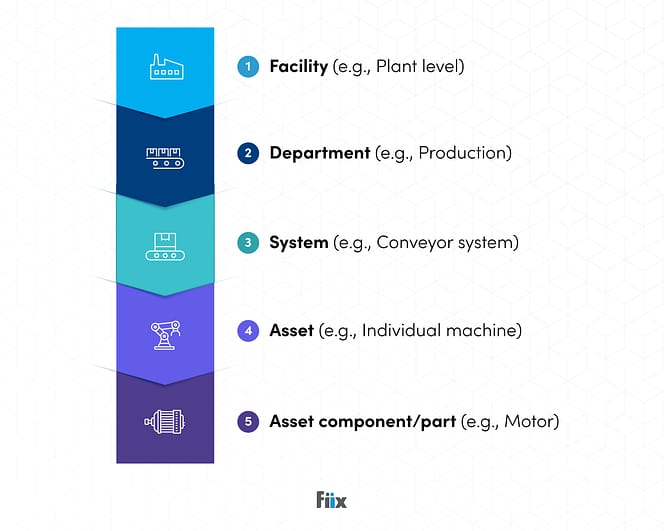
In a manufacturing setting, for example, an asset hierarchy could start with the entire facility (plant level), go down to specific departments (e.g., production and packaging), then to systems within those departments (e.g., conveyor systems), individual equipment or machinery, and finally the components within each piece of equipment (e.g., motors or pumps).
How to set up an asset hierarchy
To build an asset hierarchy like in our example above, you need to start by mapping out your plants’ physical layout and identifying the functional relationships between the different assets. Here’s a simple step-by-step process to set it up:
Define the top level: The highest level represents the entire facility or plant.
Identify your departments: Break down the plant into key departments or functional areas, like production, quality control, or maintenance.
Organize your systems within each department: Identify the major systems within each department, such as the HVAC or conveyor system.
List all of the assets for each system: Drill down further to identify the equipment or assets in each system.
Pinpoint any components: Lastly, include individual components that may require separate maintenance (e.g., pumps, belts, motors).
Each layer of the hierarchy should be clearly defined, allowing maintenance teams to trace issues back to their source.
What is ISO 14224 and why is it important to asset hierarchy?
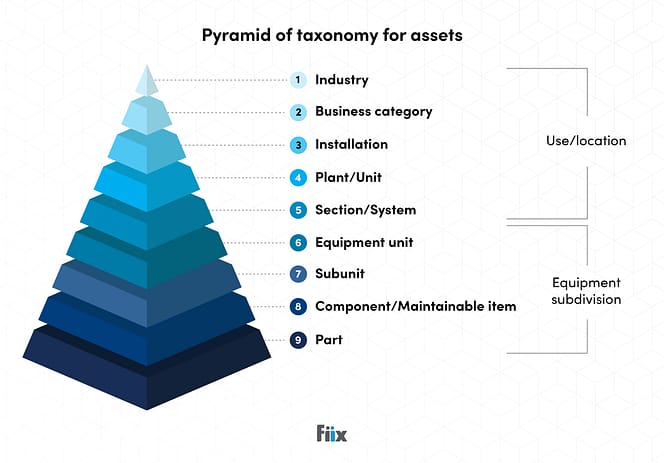
ISO 14224 is an international standard that provides guidelines for collecting and managing reliability and maintenance data for equipment within the oil, gas, and petrochemical industries. It was developed by the International Organization for Standardization (ISO), and it’s important to asset hierarchy because it offers a framework for classifying equipment, setting up asset hierarchies, and capturing critical information such as failure modes, maintenance history, and reliability data. The ISO 14224 standard provides a hierarchical pyramid for taxonomic classification consisting of nine levels.
The example above illustrates the typical pyramid of taxonomic classification. Level 1, at the very top, represents the type of industry, while Level 9, at the bottom, represents a specific part of an individual asset. Assets sit at level 6, this can include any machines, IoT sensors, motors, pumps, etc.
With a clear asset hierarchy like this one, data collection is consistent across systems and equipment in a common format. ISO 14224 also specifies what data should be collected at each level of the hierarchy, this can include failure rates, repair times, and maintenance types. By defining and using standardized asset hierarchy with clear data, it allows teams to develop reliable benchmarking. Then organizations can track their asset performance and compare them against industry norms. It also makes it easier to predict and prevent failures, since the asset hierarchy simplifies the tracking and analysis of maintenance events.
Setting up an asset hierarchy in a CMMS begins by creating an underlying structure for assets. There are several different ways to set up a hierarchy in a CMMS. Within a CMMS top-down hierarchy might look like this:
Site or plant level: The highest level may include multiple plants if the company operates in different locations.
Department level: Different departments or function areas (e.g., production, quality control, maintenance).
System level: Major systems within each department (e.g., conveyor systems, HVAC).
Asset level: Individual pieces of equipment that comprise each system and their unique attributes (e.g., asset criticality, serial number, asset ID, etc.).
Component level: Specific parts of the asset, such as motors, pumps, belts, and control panels.
This structured setup helps maintenance teams drill down from broader plant-level maintenance needs to individual asset or component-level actions, ensuring each layer is maintained effectively. Some CMMSs’ also have set rules for setting up asset hierarchies.
CMMS asset hierarchy example
Let’s say a technician at a bottling plant receives a CMMS alert that there’s an issue with a bottling conveyor belt and it’s not running properly. By navigating the CMMS asset hierarchy:
The technician can start from the site or plant level and quickly drill down to the department level, which is the packaging area, and then to the system level, which in this example is the bottling line system, and locate the bottling conveyor belt which is the asset level.
Within the bottling conveyor belt, they can look at the component level and identify specific components, like the motor or rubber belt on the conveyor line that might be causing the issue. With systems like these, parts can wear down after prolonged use.
This structured hierarchy in a CMMS makes it easier for maintenance teams to navigate, isolate issues, and conduct repairs efficiently without downtime. It also supports historical data tracking, allowing maintenance teams to analyze past repairs at each level for optimized performance. Ensuring that your asset naming conventions are clear and consistent will help make things easier to find on your CMMS.
Best practices for naming conventions for your asset hierarchy
Naming conventions for your asset hierarchy are essential to maintain consistency, improve navigation, and streamline communication across your team. Here are some best practices for creating a clear and practical naming convention for asset hierarchy in a CMMS:
Standardize naming across all levels of the hierarchy
Use descriptive but concise names
Incorporate location codes
Utilize function-based codes
Include equipment type and ID numbering
Avoid special characters
Document naming conventions and train staff
Include manufacturer or model information if relevant
Prioritize unique identifiers for critical assets
Last but certainly not least, the final step, step 10, would focus on always including your full maintenance and operations team in the development of your asset naming conventions. This is important for two core reasons:
So that when a technician for example sees an asset code, they know exactly what that asset is.
So that communication between maintenance and operations can be streamlined, thus saving time for both teams when there is an issue.
Understanding the parent-child relationship in asset hierarchy
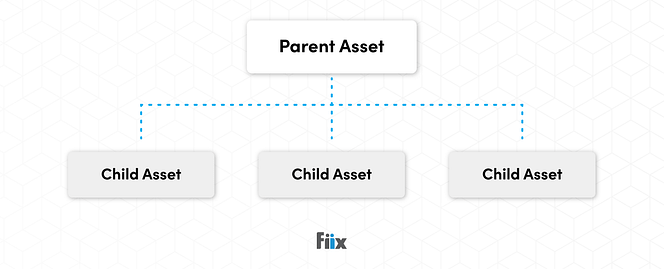
In asset management, the parent-child relationship refers to the hierarchal structure where a parent asset is a higher-level or more complex asset that includes one or more child assets.
The illustration above shows the relationship visually. The parent asset is always at the top and it can have multiple child assets, but any child asset is limited to a single parent. Below is a table to help you understand the difference between the two when it comes to asset hierarchy:
A higher-level asset that comprises of multiple components or sub-assemblies.
A component, sub-assembly, or part that belongs to and depends on a parent asset.
Examples
A production line in a factory.An HVAC system in a building.A server rack in IT infrastructure.
Motors, conveyors, and IoT sensors in a production line.Air handling units and compressors in an HVAC system.Individual servers and network switches on a server rack.
There are several benefits of parent-child asset relationships, the most obvious being improved asset tracking and maintenance planning. However, the relationship also offers a unique way to organize asset hierarchies. In this case, it provides a clear mapped-out view of asset dependencies and organization. This makes it a lot easier for maintenance planners to see their data and analyze it at both parent and child levels for better decision-making.
Standardize asset naming conventions: A consistent naming system for assets, systems, and components simplifies navigation and search.
Train maintenance teams on CMMS usage: Familiarize team members with the asset hierarchy structure and show them how to navigate it within the CMMS.
Conduct regular audits: Schedule periodic reviews of the asset hierarchy to ensure all equipment and components are accurately represented and updated as changes occur.
Integrate data across departments: Ensure the CMMS integrates with other department systems, such as procurement and finance, for a complete picture of asset performance and cost.
Utilize feedback from technicians:Maintenance personnel can provide valuable insights on what changes may be needed within the hierarchy for practical, on-the-job usage.
Setting up asset hierarchy is a key step for maintenance management
Asset hierarchy allows teams to understand their plant operations from the facility down to each part or component needing attention. Whether teams are using a CMMS software like Fiix or manually setting up their hierarchies, a clear, and concise structure lets maintenance and operations teams streamline their work and enhance their overall equipment efficiency.
Accounting firms are facing new data security challenges from platforms like ChatGPT, Google Gemini, and Microsoft Copilot. Some knowledge workers are sharing client data with public GenAI platforms despite firm instruction. They use these platforms for a wide range of tasks such as accounting research, reviewing workpapers, client communications, and more.
Firms need to identify how to incorporate AI into their tech stack safely and securely. The best path forward is to provide their staff with firm-approved resources.
In this blog, we will explore how accountants can use Aino in their daily work with examples directly from the system.
Gain Time With AI-Powered Accounting
As someone that has previously worked in public accounting, I am familiar with juggling hundreds of documents across multiple clients and deadlines all within a couple of months. Reviewing these documents to familiarize myself with the client’s unique approach and understanding if this is even what I asked for was a regular occurrence. We were always looking for a better way!
Powered by M-Files generative artificial intelligence (AI) technology, Aino takes knowledge work to the next level by placing your firm’s information base at your fingertips. M-Files Aino organizes information, understands the context of documents, and allows users to interact with their content easily. Aino saves users time through automating necessary administrative tasks such as content summarization, accounting research, data entry and more!
Aino’s natural language model makes it simple for users to interact with their content and the platform.
The Natural Language Processing (NLP) Advantage
NLP techniques allow computers to understand human language. They bridge the gap between what humans speak and write and what computers can process. According to Gartner, “NLP provides intuitive forms of communication between humans and systems. NLP includes computational linguistic techniques (symbolic and subsymbolic) aimed at recognizing, parsing, interpreting, automatically tagging, translating, and generating (or summarizing) natural languages.”*
M-Files Aino is an example of how human users can interact with NLP technology. Aino has the capability to translate and generate text based on from partners to staff. Additionally, Aino can tag documents with metadata generated by Aino.
Aino Saves Time
According to the Work Trend Index Annual Report, 70% of people would delegate work to AI to lessen their workloads. Business leaders are twice as likely to say AI will provide value by boosting productivity versus cutting headcounts.
In the next section, we will focus on the following types of documents accountants frequently work on or receive from clients:
Engagement Letters/ Contracts
Leases
Client Provided Support
Confirming Completeness
When it comes to engagement letters and contracts, first accountants will identify if it is fully executed by the authorized signers. Secondly, they will ensure the time period and fees for covered services are stated correctly. Aino can quickly identify who signed your document and when. It can also identify the total cost for the engagement.
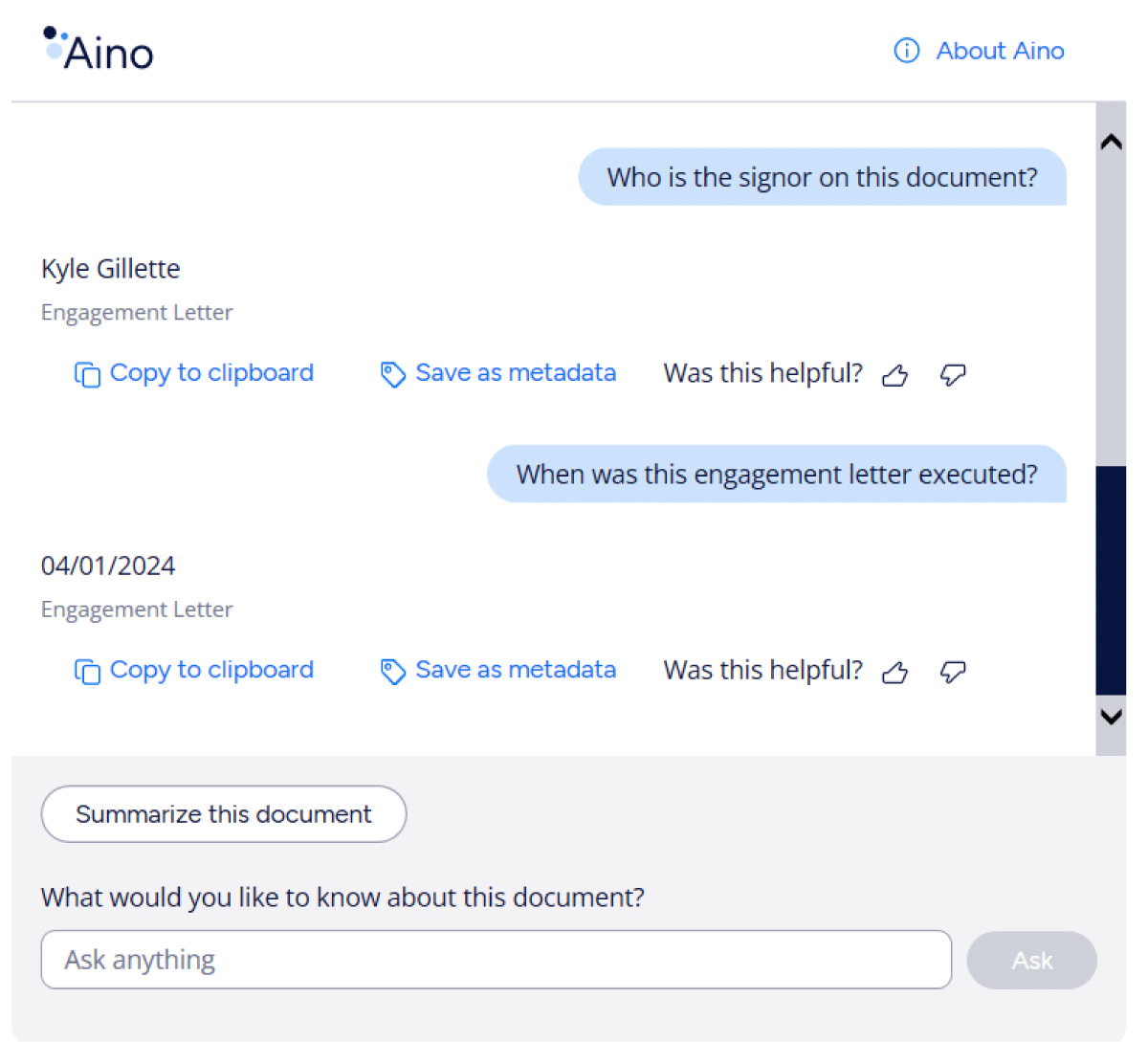
In the below example, we query Aino with three prompts. The provided answers will save us time reviewing each page manually.
Query: Who is the signor on this document?
Aino: Kyle Gillette
Query: When was this engagement letter executed?
Aino: 04/01/24
Query: How much do the services cost?
Aino: $50,000
To confirm this understanding, users can review the document either through the “preview” tab or opening the document. Users can verify that the Aino responses match the content of the document. Once they know what they are looking for, they can do this quickly.
Summarizing Content
Clients will often provide leases that are dozens of pages long. They may also be in a different language depending on the location of the leased item or asset. This increases the time the accountant needs to spend reviewing the document; to find the information they are looking for to support their findings.
With M-Files Aino, you can request a summary of the document in your language. This will allow accountants to understand if they have the correct documentation that aligns with their request. Secondly, they can ask Aino about rent cost, rent escalations, the lessor and lessee, and more. Once the accountant understands what they are looking for they can easily open the document and confirm Aino provided the correct information.
In the below example, we ask Aino more than one question at a time. Aino responds to each question accordingly.
Query: Who are the lessor and lessee in this lease?
Aino: Lessor: Real Estate Inc. Lessee: Acme
Query: How much does year 1 rent cost?
Aino: Year 1 rent cost: $60,000.00
Query: How much does rent increase annually between year 1 and year 2?
Aino: Rent increase annually between year 1 and year 2: $10,000.00
Query: Are there any other rent escalations in this lease?
Aino: There are other rent escalations in this lease, with the rent increasing by $10,000.00 annually.
Managing Client Provided Support
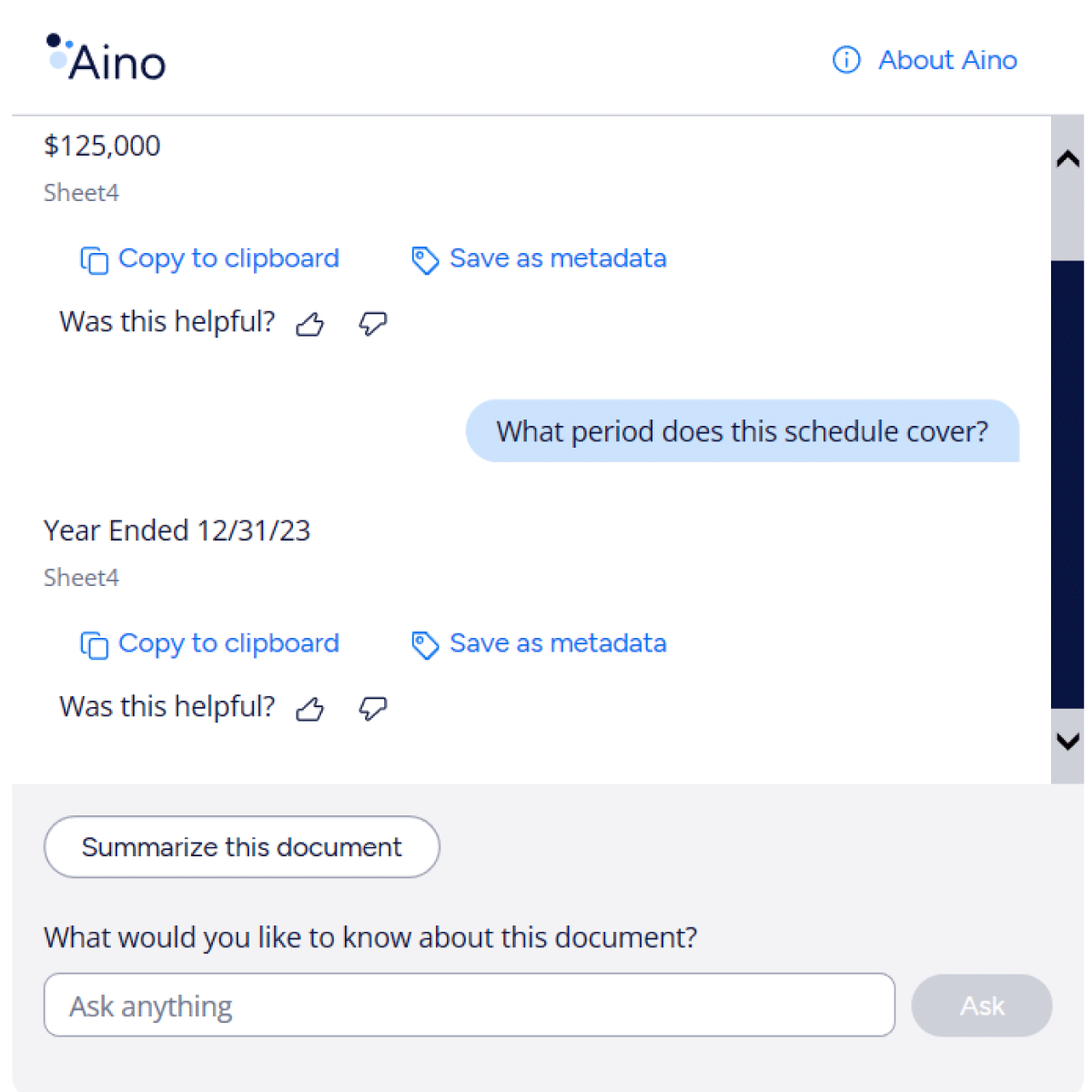
Clients provide data sets in various formats such as Microsoft Excel and PDF. To save accountants time formatting these documents, they can ask Aino specific questions about client schedules or listings. In the example below, we ask Aino to calculate the total expenses across multiple transactions.
Query: What are the total advertising expenses?
Aino: $125,000
Query: What period does this schedule cover?
Aino: For the year ended 12/31/23.
After reviewing the expense schedule, we can see that $125,000 out of $228,000 in total marketing expenses were attributed to advertising expenses for the period ended on 12/31/23.
FAQ
Q: Our firm manages a lot of sensitive information. How does M-Files Aino ensure the security and confidentiality of my client’s information?
A: Aino follows the security and access rights already established in your M-Files vault. Users will only be able to query or prompt documents they have access to. Unlike public GenAI platforms, information and queries stored in M-Files remain within the firm’s security environment overall reducing risk of security breach.
Q: M-Files Aino utilizes Natural Language Processing (NLP). Is there a learning curve for using this technology effectively?
M-Files Aino can be used right away as M-Files platform uses metadata and Optical character recognition (OCR) technology to understand the content in the document. The database from which Aino summarizes or provides information already exists in your vault. Due to M-Files‘ ability to maintain a single-source-of-truth and organize documents based on what they are not where they are stored, Aino can easily and quickly get to work assisting its users.
Courtney Kunzig, CPAIndustry Solutions Manager, AccountingM-Files
Courtney Kunzig, a seasoned accountant with diverse experience spanning various roles and industries, currently serves as the Industry Solutions Manager for Accounting at M-Files. Her expertise lies in leveraging technology to enhance employee experiences, streamline manual processes, and optimize time management within the accounting domain.
Kunzig explores the critical role of artificial intelligence and automation for accounting firms. The article delves into practical applications and strategies for reducing manual tasks and embarking on a digital transformation.
Kunzig discusses innovative strategies for addressing skills gaps in the accounting industry. She emphasizes the importance of retention and automation in nurturing talent and maintaining competitiveness.
Kunzig sheds light on the pivotal role of artificial intelligence in bolstering cybersecurity within accounting firms. Her article explores practical applications and proactive measures to safeguard sensitive data.
Courtney Kunzig’s thought leadership and contributions underscore her commitment to advancing the field of accounting through technology-driven solutions. Her expertise resonates with professionals seeking to optimize workflows, ensure compliance, and elevate client experiences.




Recent Comments