Our Senior Manager, Industry Solutions, Yohan Lobo, spoke to Startups Magazine about the importance of patience, preparation and automation when it comes to AI integration.
The past year has seen a rapid acceleration in the rate of adoption of Generative AI (GenAI) solutions.
McKinsey’s ‘State of AI in early 2024’ report revealed that the number of organisations that regularly use GenAI has doubled within the past year, with this figure now at 65%.
However, despite the growing popularity and wholesale integration of this technology, companies that rush to implement GenAI to maintain pace with rivals could see unreliable solutions hinder, rather than improve, business performance.
According to Yohan Lobo, Senior Industry Solutions Manager at M-Files, organisations should ensure the necessary building blocks are put in place before GenAI takes up a central role in business processes.
Yohan said: “After the meteoric rise of this technology, we’re seeing people begin to question whether GenAI solutions truly deserve the level of hype and attention they have received over the past two years. While there is certainly an inflated sense of what can be achieved with GenAI, there are still a number of tangible use cases that can add genuine value to businesses across industries.”
“Summarising documents, creating content from scratch, and even performing translations are all ways that GenAI solutions can be deployed to drive improvements in efficiency. A GenAI strategy that respects security and compliance policies and allows businesses to leverage their data to its full potential can yield enviable results, improving the experience of both employees and customers in the process.
“Where issues arise is when management teams are over-eager and rush into GenAI implementation. Any effective AI strategy should be built on a foundation of structured data that is searchable and organised using metadata, as this is the only way the outputs of a GenAI solution can be fully trusted.
“Getting ‘AI ready’ by conducting a thorough data audit and ensuring that the business has an extensive and reliable store of internal data that its GenAI tool can collate responses from is essential. Any GenAI solutions that are dependent on external information to provide answers simply can’t be trusted – a lack of understanding of where data is coming from is the most common pitfall of GenAI deployment.”
Alongside the development of GenAI, it is crucial that organisations continue to invest in technology that automates processes.
Yohan continued: “With such intense global interest in GenAI and how this technology can be utilised it’s easy to become blinkered, but there are a whole host of alternative ways of improving efficiency businesses should consider.
“For example, automated systems can handle large volumes of work without fatigue, enabling organisations to scale operations more effectively, and perform repetitive and time-consuming tasks, freeing up employees to take on more strategic and creative work. Greater automation also means less manual error, with businesses benefiting from improved security and a better experience overall for the end customer.”
Yohan concluded: “Once organisations have tended to their internal data and made sure that it is properly ordered and maintained can they deliver a GenAI strategy with confidence. Balancing this with automation that ensures routine tasks are handled efficiently, accurately, and consistently is a clear recipe for success moving forward.”
Creating an asset hierarchy is essential for efficient maintenance management in any manufacturing capacity. A well-structured hierarchy simplifies your maintenance and enhances asset tracking, asset management, asset performance monitoring, spare parts management, and ultimately, cost savings. In this blog we’ll explore the basics of asset hierarchy, provide examples, and offer some insights into setting it up for your maintenance team.
What is an asset hierarchy?
An asset hierarchy is an organized structure that breaks down assets within an organization into multiple levels, from high-level facilities to individual components. The hierarchy visualizes how assets are related and helps streamline asset management, maintenance, and troubleshooting processes.
Asset hierarchy example
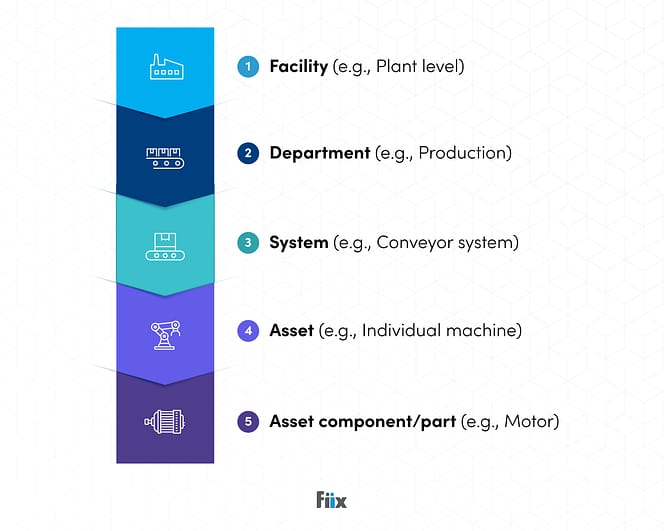
In a manufacturing setting, for example, an asset hierarchy could start with the entire facility (plant level), go down to specific departments (e.g., production and packaging), then to systems within those departments (e.g., conveyor systems), individual equipment or machinery, and finally the components within each piece of equipment (e.g., motors or pumps).
How to set up an asset hierarchy
To build an asset hierarchy like in our example above, you need to start by mapping out your plants’ physical layout and identifying the functional relationships between the different assets. Here’s a simple step-by-step process to set it up:
Define the top level: The highest level represents the entire facility or plant.
Identify your departments: Break down the plant into key departments or functional areas, like production, quality control, or maintenance.
Organize your systems within each department: Identify the major systems within each department, such as the HVAC or conveyor system.
List all of the assets for each system: Drill down further to identify the equipment or assets in each system.
Pinpoint any components: Lastly, include individual components that may require separate maintenance (e.g., pumps, belts, motors).
Each layer of the hierarchy should be clearly defined, allowing maintenance teams to trace issues back to their source.
What is ISO 14224 and why is it important to asset hierarchy?
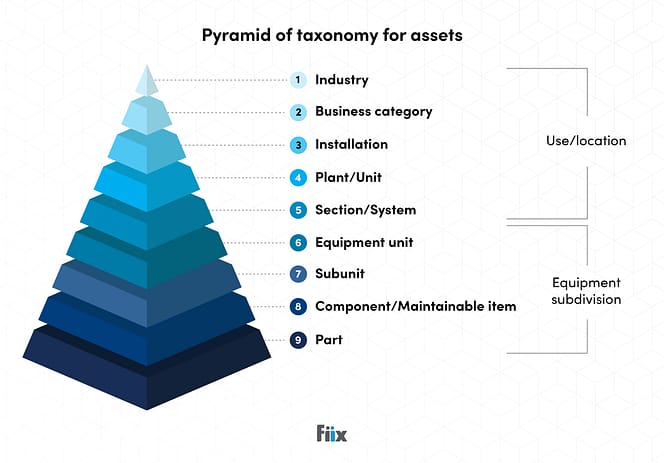
ISO 14224 is an international standard that provides guidelines for collecting and managing reliability and maintenance data for equipment within the oil, gas, and petrochemical industries. It was developed by the International Organization for Standardization (ISO), and it’s important to asset hierarchy because it offers a framework for classifying equipment, setting up asset hierarchies, and capturing critical information such as failure modes, maintenance history, and reliability data. The ISO 14224 standard provides a hierarchical pyramid for taxonomic classification consisting of nine levels.
The example above illustrates the typical pyramid of taxonomic classification. Level 1, at the very top, represents the type of industry, while Level 9, at the bottom, represents a specific part of an individual asset. Assets sit at level 6, this can include any machines, IoT sensors, motors, pumps, etc.
With a clear asset hierarchy like this one, data collection is consistent across systems and equipment in a common format. ISO 14224 also specifies what data should be collected at each level of the hierarchy, this can include failure rates, repair times, and maintenance types. By defining and using standardized asset hierarchy with clear data, it allows teams to develop reliable benchmarking. Then organizations can track their asset performance and compare them against industry norms. It also makes it easier to predict and prevent failures, since the asset hierarchy simplifies the tracking and analysis of maintenance events.
Setting up an asset hierarchy in a CMMS begins by creating an underlying structure for assets. There are several different ways to set up a hierarchy in a CMMS. Within a CMMS top-down hierarchy might look like this:
Site or plant level: The highest level may include multiple plants if the company operates in different locations.
Department level: Different departments or function areas (e.g., production, quality control, maintenance).
System level: Major systems within each department (e.g., conveyor systems, HVAC).
Asset level: Individual pieces of equipment that comprise each system and their unique attributes (e.g., asset criticality, serial number, asset ID, etc.).
Component level: Specific parts of the asset, such as motors, pumps, belts, and control panels.
This structured setup helps maintenance teams drill down from broader plant-level maintenance needs to individual asset or component-level actions, ensuring each layer is maintained effectively. Some CMMSs’ also have set rules for setting up asset hierarchies.
CMMS asset hierarchy example
Let’s say a technician at a bottling plant receives a CMMS alert that there’s an issue with a bottling conveyor belt and it’s not running properly. By navigating the CMMS asset hierarchy:
The technician can start from the site or plant level and quickly drill down to the department level, which is the packaging area, and then to the system level, which in this example is the bottling line system, and locate the bottling conveyor belt which is the asset level.
Within the bottling conveyor belt, they can look at the component level and identify specific components, like the motor or rubber belt on the conveyor line that might be causing the issue. With systems like these, parts can wear down after prolonged use.
This structured hierarchy in a CMMS makes it easier for maintenance teams to navigate, isolate issues, and conduct repairs efficiently without downtime. It also supports historical data tracking, allowing maintenance teams to analyze past repairs at each level for optimized performance. Ensuring that your asset naming conventions are clear and consistent will help make things easier to find on your CMMS.
Best practices for naming conventions for your asset hierarchy
Naming conventions for your asset hierarchy are essential to maintain consistency, improve navigation, and streamline communication across your team. Here are some best practices for creating a clear and practical naming convention for asset hierarchy in a CMMS:
Standardize naming across all levels of the hierarchy
Use descriptive but concise names
Incorporate location codes
Utilize function-based codes
Include equipment type and ID numbering
Avoid special characters
Document naming conventions and train staff
Include manufacturer or model information if relevant
Prioritize unique identifiers for critical assets
Last but certainly not least, the final step, step 10, would focus on always including your full maintenance and operations team in the development of your asset naming conventions. This is important for two core reasons:
So that when a technician for example sees an asset code, they know exactly what that asset is.
So that communication between maintenance and operations can be streamlined, thus saving time for both teams when there is an issue.
Understanding the parent-child relationship in asset hierarchy
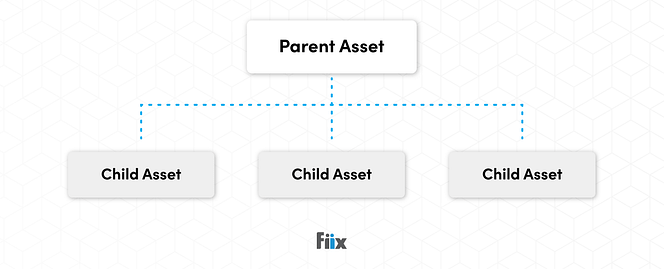
In asset management, the parent-child relationship refers to the hierarchal structure where a parent asset is a higher-level or more complex asset that includes one or more child assets.
The illustration above shows the relationship visually. The parent asset is always at the top and it can have multiple child assets, but any child asset is limited to a single parent. Below is a table to help you understand the difference between the two when it comes to asset hierarchy:
A higher-level asset that comprises of multiple components or sub-assemblies.
A component, sub-assembly, or part that belongs to and depends on a parent asset.
Examples
A production line in a factory.An HVAC system in a building.A server rack in IT infrastructure.
Motors, conveyors, and IoT sensors in a production line.Air handling units and compressors in an HVAC system.Individual servers and network switches on a server rack.
There are several benefits of parent-child asset relationships, the most obvious being improved asset tracking and maintenance planning. However, the relationship also offers a unique way to organize asset hierarchies. In this case, it provides a clear mapped-out view of asset dependencies and organization. This makes it a lot easier for maintenance planners to see their data and analyze it at both parent and child levels for better decision-making.
Standardize asset naming conventions: A consistent naming system for assets, systems, and components simplifies navigation and search.
Train maintenance teams on CMMS usage: Familiarize team members with the asset hierarchy structure and show them how to navigate it within the CMMS.
Conduct regular audits: Schedule periodic reviews of the asset hierarchy to ensure all equipment and components are accurately represented and updated as changes occur.
Integrate data across departments: Ensure the CMMS integrates with other department systems, such as procurement and finance, for a complete picture of asset performance and cost.
Utilize feedback from technicians:Maintenance personnel can provide valuable insights on what changes may be needed within the hierarchy for practical, on-the-job usage.
Setting up asset hierarchy is a key step for maintenance management
Asset hierarchy allows teams to understand their plant operations from the facility down to each part or component needing attention. Whether teams are using a CMMS software like Fiix or manually setting up their hierarchies, a clear, and concise structure lets maintenance and operations teams streamline their work and enhance their overall equipment efficiency.
M-Files Founder and CEO Antti Nivala shares practical insights on how to incorporate responsible Artificial Intelligence (AI) into an organization’s knowledge management (KM) strategy in his newest contributed article published in Forbes.
Antti shares, “Knowledge is power. It holds the context and insight required to drive business forward. However, knowledge is often trapped in data silos—stuck on a server or lost in a forgotten folder. That valuable information, such as a deep understanding of customer preferences or unique trends, holds enormous potential only AI can likely uncover.
Artificial Intelligence (AI) has the capability to uncover deep insights and information dispersed across documents, emails, and conversations. For many organizations, it serves as the intelligence that drives problem-solving and enhances the efficiency of knowledge workers. However, with greater intelligence, comes significant responsibility.
With many feeling the needto keep up with the latest advancements in AI as a competitive advantage, it is necessary organizations take their time to understand its impact on the business. As the pace of innovation increases, so does the need for a balance between innovation and security.
In the article, Antti discusses how assessing three specific aspects of data – Connectivity, Curation and
Connectivity AI can help overcome the challenge of information overload head-on and unlock the value of unstructured data. But to be effective, we must ensure AI is working as intended and relaying accurate information.
Identifying vendors committed to deploying accurate tools to minimize AI hallucinations can also help your enterprise from falling victim.
Curation With the influx of information generated across an organization, it’s important to understand what data AI models are trained on to ensure the information being leveraged is current, accurate and valuable.
Having a better understanding of how your data is curated and interacts with AI can ensure you are confident in the way you leverage the context of documents and interact with your organization’s knowledge.
Confidentiality Even though adopting AI has many benefits, it inevitably raises concerns about data privacy and confidentiality.
Enterprises shouldn’t be afraid to examine vendor AI usage policies to make sure AI models can comply with their organization’s information security protocols and aren’t being trained on their data without their written consent.
Ensuring Guidelines To get the most out of AI in your information management strategy, it’s important to establish clear guidelines and standards around AI’s usage while enabling successful AI deployment with capabilities for connectivity, curation and confidentiality. A metadata structure within your information management system also supports the need for data consistency and helps you identify, manage and enforce AI data policies as it provides an information model specific to each customer’s content.
Progressive organizations need to leverage their capacity to assimilate information and extract insights. AI has the power to revolutionize our knowledge work processes, liberating employees from monotonous, time-consuming tasks and converting information into a catalyst for growth. However, it is crucial for us to evaluate and oversee the impact of our AI and information technology to avoid potential pitfalls.
In 1970, futurist Alvin Toffler published a book entitled “Future Shock”, which covers?the psychological distress and anxiety caused by rapid technological and societal change. Toffler’s feeling was that most of society’s problems are symptoms of ‘information overload’.
Ironically, the problem is exacerbated by technology itself. Internet ‘cookies’ and AI algorithms track our digital behaviors to curate data to sling at our hungry eyeballs, which are glued to the ubiquitous screens and devices we carry with us everywhere. Navigating, processing, assimilating, and making sense of all this information is not only an exercise in futility, but it is also unnatural and unhealthy.
Initially, I considered this issue to be merely an annoyance and something to kvetch about at parties. After all, we always have the option to ignore the noise and side-step the issue all together, right? Well, not really. That may work in our personal lives but in a professional context, many of us are under increasing pressure to innovate, drive better outcomes, and do more with less… yesterday! Like it or not, we need to pay attention to what’s happening. This is particularly true when it comes to keeping up to date on AI, where ignorance is not bliss and getting it wrong could have dire consequences. So… what can we do?
Unfortunately, there is no easy “fix.” However, one thing sprung to mind while watching a pro hockey game this week, my favorite sport. Don’t chase. For those of you who have never played a sport, this may be a new concept, but it is simple. In sports like soccer, hockey, or basketball, when the coach yells “don’t chase” it means the players should avoid frantically pursuing the ball, puck, or their opponents in a disorganized manner. Instead, they should maintain their position, stay disciplined, and anticipate the play, allowing them to respond strategically rather than reactively. Get the picture?
Applying this one simple tweak will not turn off the firehose of information hitting us daily. But with some prep work and practice, it will help you remain “in the pocket” (calm under pressure) allowing you to mindfully select what you give your attention to.
Here’s why it’s important and how it applies to both sports and your corresponding professional role:
Maintain Positioning: When players chase, or over-commit, they often leave their assigned positions, creating gaps and opportunities for the opposing team. Staying in position helps maintain the team’s structure and reduces vulnerabilities. In your job, this means to avoid getting sucked into every AI article, opinion, trend, opinion or webinar. Note that a pre-requisite here is having a documented AI strategy or at least a core set of priorities as a foundational structure. Without a plan, you are more prone to inefficient chasing because there is no baseline for the priorities.
Conserve Energy: Constantly chasing can lead to fatigue, which affects performance during a game. By playing smarter and picking their moments, players can conserve energy for when it is needed most. In our daily work, there are only so many hours in each day. Following an AI game plan lets you avoid wasting your energy, and maximizes your more precious resource, time.
Control the Pace: Rather than letting the opponent dictate the pace, not chasing allows players to be patient and make decisions based on the flow of the game. It helps them to cut off passing lanes and force turnovers by waiting for the right moment. In a professional context, the key phrases here are “be patient” and “waiting for the right moment.” When the world feels like it is moving too fast, hit the pause button and zoom out for a wider perspective. The thing that is moving too fast is likely you.
The “don’t chase” concept encourages players to stay composed, trust in the team strategy, and let the game come to them instead of trying to control everything through sheer effort. Again, this presumes you already have an AI strategy in place. If this is not the case, here are a couple of thoughts to get you rolling.
Don’t over think it. Start with your organization’s business goals as a foundation. Your AI plans should align with the company’s priorities and strategic objectives, rather than being created in a vacuum as a stand-alone document. Also crucial here is involving your legal, risk, and executive leadership teams at the earliest stages of this process.
Incorporate AI Principles: Establishing a set of key AI principles along with the strategy will ensure there are rules of the road and guardrails to help you meet your ethical, legal, societal, and regulatory goals and requirements. While it’s useful to view other’s principles (normally listed on their web sites), it’s important to make these unique to your organization. Don’t underestimate the time required here. At Nuix we spent several weeks on this, including a detailed crosswalk of the AI regulations that are most relevant to our geographic footprint, industry, and customer base. This could work for you too.
Think Big, Start Small: While you should embrace a big and exciting long-term vision, including identifying the domains where AI makes sense for your business, start with tangible but low risk use cases—low hanging fruit—that can make an impact, generate some organizational mindshare, achieve some experiential learning, and build some internal confidence.
Like the weather, information overload is unavoidable. And despite what you might imagine, no one is keeping up with all of this. I have heard PhD’s and AI experts admit that they cannot remain current because things are simply changing too quickly. Knowing this should bring some peace of mind. Don’t chase: Maintain positioning (follow your plan); conserve your energy (pay attention to what’s relevant and let the rest sail by); and maintain a healthy pace (Quality is never an accident; it is always the result of intelligent effort).
Knowledge is power. Information overload makes you powerless.



Recent Comments